

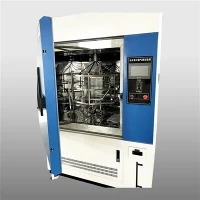


The maximum stroke of the crosshead in a tensile test chamber is a critical parameter that greatly determines the equipment's testing capacity and applicable scenarios. As a supplier of tensile test chambers, ALP Technology recognizes that mastering this specification is essential to deliver the most appropriate solutions to our customers.
Understanding the Crosshead in a Tensile Test Chamber
The crosshead serves as the core moving component inside a tensile test chamber. It delivers tensile or compressive load to the test specimen. The crosshead travels vertically along the machine frame, and its total travel distance is defined as stroke. This parameter governs the maximum usable length of test specimens and limits the range of deformation that can be applied to samples during testing.
Factors Affecting the Maximum Stroke
1. Test Requirements
Diverse test standards and applications impose different demands on maximum stroke. For instance, testing long flexible materials such as ropes and cables requires an extended stroke to adequately simulate real stretching conditions. On the contrary, tests on small rigid specimens including metallic samples may only need a relatively short stroke.
2. Machine Design and Structure
The mechanical layout of the tensile test chamber exerts a decisive influence on maximum stroke. Key constraints include vertical column length, guide system configuration and driving unit performance. A well-engineered unit equipped with a sturdy, high-precision guide system enables longer stroke with superior positioning accuracy.
3. Safety Considerations
Safety remains the top priority for all laboratory testing. The maximum stroke is also bounded by the machine's built-in safety mechanisms. These protections prevent crosshead overtravel, which may lead to equipment damage, specimen failure or potential hazards to operators.
Determining the Optimal Maximum Stroke
1. Analysis of Customer Requirements
As a supplier of tensile test chambers, ALP Technology collaborates closely with customers to clarify their unique testing demands. We collect information covering material types, specimen dimensions, expected deformation range, and mandatory industry standards. Based on these details, we can recommend the optimal maximum stroke matching their practical applications.
2. Balancing Cost and Performance
A longer maximum stroke generally demands sophisticated mechanical structures and higher-performance drive systems, which raises overall equipment costs. At ALP Technology, we strike a reasonable balance between sufficient stroke capacity and budget control, thoroughly evaluating the trade-offs between performance targets and cost expectations.

Applications and the Role of Maximum Stroke
1. Material Research and Development
In material research, the maximum stroke of the cross - head allows scientists to study the behavior of materials under various levels of deformation. For instance, in the development of new polymers, a long stroke can help simulate the stretching and elongation that the material may experience in practical applications. This data is crucial for understanding the material's mechanical properties and improving its performance.
2. Quality Control in Manufacturing
In manufacturing industries, the maximum stroke is used to ensure the quality of products. For example, in the production of automotive parts, testing with an appropriate stroke can verify that the parts can withstand the expected forces during use. This helps to prevent product failures and recalls, ensuring the safety and reliability of the end - products.
Our Offerings as a Tensile Machine Test Chamber Supplier
We offer a wide range of Tensile Machine Test Chambers with different maximum strokes to meet the diverse needs of our customers. Our machines are designed with high - precision guiding systems and powerful drive mechanisms to ensure accurate and stable operation. Whether you are testing small components or long, flexible materials, we have a solution for you.
In addition to our Tensile Machine Test Chambers, we also provide Temperature - vibration Test Chamber which can simulate more complex environmental conditions. These chambers can be used in combination with our tensile machines to conduct comprehensive tests on materials and products.
If you are interested in our Tensile Machine Test Chamber or other testing equipment, we encourage you to contact us for more information. Our team of experts is ready to assist you in selecting the most suitable machine for your specific requirements. We can also provide detailed technical support and after - sales service to ensure that you get the most out of your investment.
Conclusion
The maximum stroke of the cross - head in a tensile machine test chamber is a crucial parameter that affects the testing capabilities and applications of the machine. As a supplier, we understand the importance of providing accurate information and suitable solutions to our customers. By considering factors such as test requirements, machine design, and safety, we can help our customers choose the optimal maximum stroke for their needs. If you are in the market for a tensile machine test chamber or related testing equipment, don't hesitate to reach out to us for a consultation.
References
- ASTM International standards for tensile testing.
- ISO standards related to mechanical testing of materials.
- Technical literature on the design and operation of tensile testing machines.
Whether you are standardizing a new product line or solving a difficult failure issue, ALP TECHNOLOGY is ready to help.
✉️ E-mail: info@alp-environment.com
🔗 Website: www.alp-environment.com
"Technological Excellence Rooted in Integrity" - engineered into every test, delivered with every partnership.