


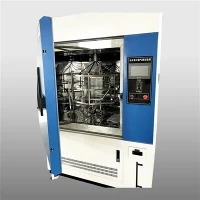


If you’ve ever worked in industries that rely on weathering testing—think automotive parts, outdoor textiles, packaging materials, or even architectural coatings—you know that xenon test chambers are non-negotiable tools. They simulate the full spectrum of sunlight, plus moisture and temperature shifts, to replicate years of outdoor aging in just weeks. But for many of my clients, whether they’re new to quality control or scaling up production, one question keeps coming back: Can a xenon test chamber really handle long-term continuous testing? As a supplier of these systems, I get it. Long runs are expensive, time-sensitive, and often tied to critical product launches, so you can’t afford downtime or inconsistent results.
Let’s start by defining what “long-term continuous testing” actually means in this context. For our purposes, it’s not a 24-hour cycle here or there—it’s multi-day, multi-week, even multi-month runs where the chamber needs to maintain precise light intensity (within ±5% of the set value), temperature, and relative humidity without pausing. Think 1,000-hour ISO 4892 accelerated aging tests, or longer custom runs for materials that degrade slowly, like UV-stabilized polycarbonate for playground equipment or marine-grade paint. The short answer is yes, modern xenon test chambers can absolutely handle this— but only if you pick the right model, operate it correctly, and plan for the maintenance that comes with continuous use.
First, let’s break down the two core cooling systems that power xenon test chambers, because that’s where most long-term testing challenges start. Xenon arc lamps generate massive amounts of heat—up to several kilowatts in high-intensity models—that has to be managed to keep the test environment stable. The two main cooling options are water cooling and air cooling, each suited to different long-term testing needs. If you’re running multi-week tests that require consistent light output, water cooling is often the more reliable choice, and it’s why many of our long-term clients invest in Water Cooling Xenon Test Chambers. Here’s why: water has a higher thermal capacity than air, so it can pull heat away from the xenon lamp more efficiently and evenly. For a chamber running 24/7 for 30 days straight, that means no hot spots that could skew temperature readings, and less strain on the lamp’s electrical components. I’ve had a client in the outdoor apparel industry run a 12-week test on moisture-wicking fabrics to see how they hold up to sun and rain over the course of a ski season—their water-cooled chamber ran nonstop, and they reported only minor lamp alignment checks at the halfway point, no interruptions.


That said, air-cooled xenon test chambers aren’t out of the question for long-term testing, especially if your runs aren’t pushing the absolute maximum intensity. Our Air Cooling Xenon Test Chambers use high-flow, variable-speed fans to dissipate heat, and many models are built with heavy-duty, continuous-duty fans that can run 24/7 for months. I recently worked with a small startup making biodegradable packaging that needed a 6-week test to track slow photodegradation in outdoor sun. They chose air cooling to save on installation costs (no need for a dedicated water line) and their only adjustment was a fan filter change every two weeks—simple, no downtime. The key here is matching the cooling system to your test’s requirements: water cooling is better for high-intensity, high-temperature long runs, while air cooling works well for lower-intensity, longer-duration tests where flexibility and lower up-front costs are priorities.
Now, beyond cooling, what other factors make a xenon test chamber suitable for continuous testing? Let’s talk about lamp longevity and stability. Xenon lamps are the heart of the chamber, and their output degrades over time. For long-term runs, you want a lamp that maintains consistent spectral output (the balance of UVA, UVB, visible, and infrared light) for thousands of hours. Most quality xenon lamps will deliver 1,500–2,000 hours of consistent performance, but some premium models last up to 3,000 hours—perfect for a 12-week run that only uses 500–700 hours of lamp time. The big mistake people make here is waiting until the lamp dies mid-test to replace it. On a recent call with a automotive parts supplier, they tried to stretch a lamp through a 10-week test, and the output dropped by 12% in week 8, which made their test data useless. We recommend setting a lamp schedule: replace it before it hits 90% of its rated life, and use a short test run at the start of each long cycle to verify light intensity.
Next, environmental control systems. Long-term testing depends on tight control of temperature (usually 35–65°C for xenon tests) and relative humidity (10–70%, depending on the standard). Cheap chambers often use outdated control systems that drift over time—by week 3 of a test, the humidity could be off by 10%, which would alter how a material ages. Our chambers use PID (Proportional-Integral-Derivative) controllers that adjust heating, cooling, and humidity in real time, maintaining stability within ±0.5°C for temperature and ±2% for RH, even after months of continuous operation. We also build in redundant sensors—if one temperature sensor glitches, a backup kicks in immediately, so you don’t have a 4-week run ruined by a single faulty reading.
But here’s the thing: even the best chamber can’t run forever without maintenance. I tell all my clients that long-term continuous testing isn’t set-it-and-forget-it—it’s planned maintenance that prevents downtime. What does that look like? First, regular filter changes. For air-cooled chambers, the intake filter keeps dust and debris out of the cooling fans and lamp housing; a clogged filter can make the chamber overheat, so every 2–4 weeks, you’ll need to replace or clean it. For water-cooled chambers, the water loop needs a periodic flush to prevent mineral buildup, especially if you’re using tap water (we recommend distilled or deionized water to cut down on this). Second, lamp and filter cleaning: dust on the lamp’s outer envelope can block light, so every 1,000 hours, you should gently wipe the lamp with a lint-free cloth and isopropyl alcohol. Third, calibration: at the start of every long test, and after every lamp change, run a calibration using a radiometer to confirm light intensity is on spec. We include free calibration checks with every chamber we sell, and our service team can do on-site calibrations if your test runs across states.
Wait, let’s address a common myth: some people think long-term continuous testing wears out chambers faster. It’s true that all equipment has a lifespan, but a properly maintained chamber running consistent, moderate conditions will last just as long as one that runs short, intermittent cycles. In fact, short, frequent starts and stops can be harder on electrical components and cooling systems than steady, continuous use. I have a client that’s had our model X-7 water-cooled chamber running 24/7 for 5 years—they do 10+ long-term tests a year, and they’ve only had to replace one cooling fan and two lamps in that time. That’s the proof right there.
Another consideration for long-term testing is test data integrity. When you’re running a test that costs thousands of dollars in materials and labor, you can’t afford to have data gaps. Modern xenon test chambers have data logging capabilities that track every parameter (light intensity, temperature, RH, lamp hours) every second, and store it securely. Some models even have remote monitoring, so if you notice a drift mid-test, you can adjust the chamber’s settings from your office, no need to be on-site. We integrate with cloud platforms that let our clients access their test data in real time, which is a game-changer for long runs. Last year, a client in the paint industry was running a 16-week test on a new exterior coating, and they noticed the RH was slowly dropping—they adjusted it remotely, without interrupting the test, and saved their data.
Now, let’s talk about edge cases. What if your long-term test needs to cycle between light and dark (condensation tests, which simulate dew)? Most modern chambers can do alternating cycles, and they’re built to handle that without issues. The key is that the cooling system is sized to handle both heating up during light cycles and cooling down during dark cycles. Water-cooled models often handle cycle changes more smoothly because water can adjust temperature faster than air. If you’re doing cyclic long-term testing, I’d still recommend water cooling for consistent performance, but our air-cooled models can do it too—just let us know the specific cycle parameters and we’ll make sure the chamber is sized correctly.
I’ve seen too many companies waste time and money by buying a cheap xenon test chamber that can’t handle long runs. They either end up with inconsistent data that has to be thrown out, or they have to pause tests every few days to fix a problem. That’s why as a supplier, I always take the time to ask clients about their test duration, intensity, and required standards before recommending a chamber. For example, if a client needs a 2,000-hour ISO 11345 test on automotive interior plastics, I’ll recommend a water-cooled model with a long-life lamp and redundant sensors. If a small lab needs a 800-hour test on paper products, an air-cooled chamber will work perfectly and save them money.
At the end of the day, the answer to “Can a xenon test chamber be used for long-term continuous testing?” is a resounding yes—if you choose the right equipment for your needs, maintain it properly, and plan for potential issues ahead. It’s not about buying the cheapest model or guessing at cooling systems; it’s about working with a supplier who understands both the technology and the specific demands of your industry. If you’re gearing up for a long-term testing project and want to make sure your chamber will hold up, I’d encourage you to reach out to discuss your requirements. We can walk you through the differences between water and air cooling, help you pick the right lamp and control system, and even share case studies from other clients in your field who’ve run successful long-term tests. Don’t let downtime or bad data derail your product launches—invest in a xenon test chamber built for continuous use, and you’ll get reliable, actionable results every time.
To learn more about our specialized chambers for long-term testing, feel free to connect with our team to discuss your procurement needs.
References:
ISO 4892-2:2016, Plastics - Methods of exposure to laboratory light sources - Part 2: Xenon-arc lamps.
ASTM G155-21, Standard Practice for Operating Xenon Arc Light Apparatus for Exposure of Non-Metallic Materials.
Morlier, P., et al. (2020). “Long-Term Stability of Xenon Arc Test Chambers for Accelerated Aging of Outdoor Materials.” Journal of Testing and Evaluation, vol. 48, no. 5, pp. 3456–3472.
National Institute of Standards and Technology (NIST). (2019). “Guide to Accelerated Weathering Testing Protocols for Commercial Products.” NIST Special Publication 1196.