


Product Overview
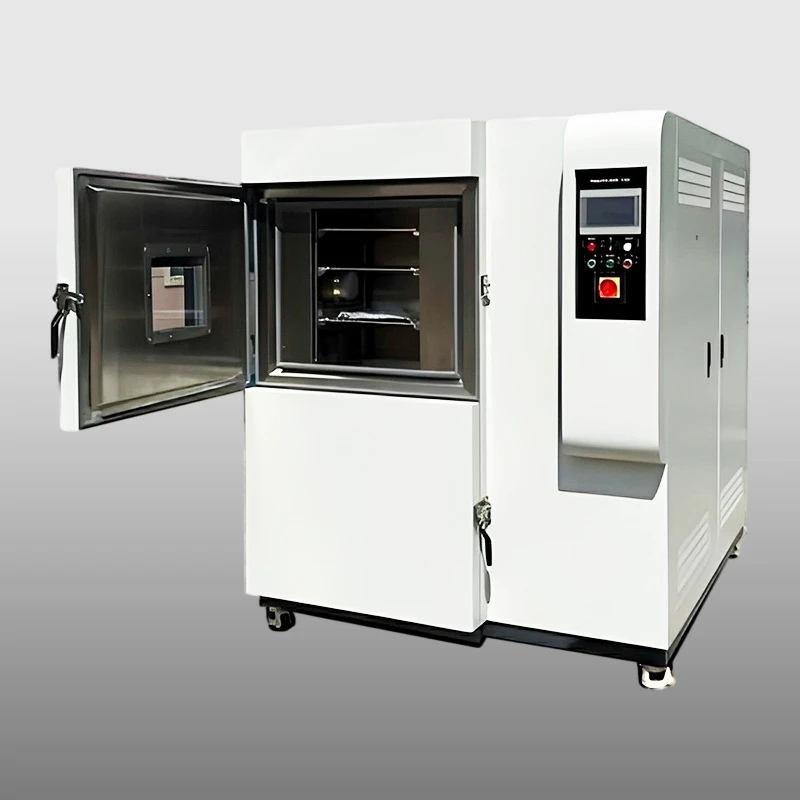
ALP Technology's 3-Zone Thermal Shock Test Chamber is a sophisticated reliability testing system designed to evaluate the resistance of materials and products to extreme, rapid temperature changes. Unlike the basket-type 2-zone design, this 3-zone thermal shock test chamber features a three-compartment configuration consisting of a high-temperature zone, a low-temperature zone, and a separate testing zone where specimens remain stationary throughout the test cycle. By using a damper-based air circulation system that rapidly switches hot or cold air into the testing zone, the 3-zone thermal shock test chamber delivers instantaneous temperature changes without subjecting the test sample to mechanical vibration from moving baskets. This makes it ideal for testing delicate components such as semiconductors, IC chips, PCBs, and materials that require simultaneous electrical monitoring during thermal shock testing.
Product Features
ALP's 3-Zone Thermal Shock Test Chamber is engineered with precision control, specimen protection, and operational efficiency in mind:
- Static Specimen Design: Test samples remain completely stationary in the middle testing zone, eliminating mechanical shock and vibration that could affect test results or damage fragile components. This design allows for easy connection of external power cables, signal lines, and monitoring equipment.
- Damper Switching Technology: Uses forced hot/cold air routing with damper opening/closing to rapidly convert temperature between the zones, achieving temperature transfer in less than 10 seconds with recovery time of ≤5 minutes.
- Wide Temperature Range: High-temperature zone reaches +60℃ to +200℃, and low-temperature zone reaches -80℃ to 0℃, supporting standard thermal shock ranges of -65℃ to +150℃.
- Flexible Test Modes: Supports multiple impact sequences including high→low, low→high, high→ambient→low, and low→ambient→high, enabling room-temperature exposure testing as required by various standards.
- Precision Control System: Features a programmable color touch screen controller supporting up to 999 cycles and 999 hours per cycle, with RS-232, RS-485, and USB communication ports for PC connection and data management.
- Advanced Refrigeration System: Uses binary cascade cooling with eco-friendly R404A and R23 refrigerants, delivering efficient cooling performance with energy savings exceeding 45% through electronic expansion valve technology.
- Extended Operation Capability: Advanced defrosting system enables continuous impact testing of up to 1000 cycles without defrosting, significantly improving test efficiency.
- Comprehensive Safety Protections: Includes over-temperature protection, compressor overpressure/overheating/overcurrent protection, earth leakage protection, phase sequence protection, and emergency stop with sound-light alarm.
Applicable Test Standards
ALP's 3-zone thermal shock test chamber is designed to comply with a broad range of internationally recognized testing standards:
- IEC 60068-2-14: Environmental testing – Change of temperature
- MIL-STD-883 Method 1010: Thermal shock test for microcircuits
- MIL-STD-810G: Environmental test methods for military equipment
- JESD22-A106B: Thermal shock for semiconductor devices
- GB/T 2423.1 / GB/T 2423.2: Environmental testing for electric and electronic products
- GJB 150.3 / GJB 150.4 / GJB 150.5: Military high/low temperature and shock tests
- MIL-STD-202G: Test methods for electronic and electrical component parts
Technical Specifications
|
Specs & Technical Parameters |
3TS-100 |
3TS-210 |
3TS-300 |
3TS-500 |
|||||
|
Pre-heat room |
Upper limit pre-heat temperature |
200℃ |
|||||||
|
Heating time |
R.T.~+200℃, about 40min (unload) |
||||||||
|
Pre-cool room |
Lower limit pre-cool temperature |
-75℃ |
|||||||
|
Cooling time |
R.T.~-70℃, about 90min(unload) |
||||||||
|
Workroom |
Temperature shock range |
-20℃,-40℃,-70℃~+150℃ |
|||||||
|
Temperature fluctuation |
≤±0.5℃ |
||||||||
|
Temperature deviation |
≤±3℃ |
||||||||
|
Transform time |
≤15S |
||||||||
|
Temperature revert time |
≤5min |
||||||||
|
Capacity |
100 L |
210 L |
300 L |
500 L |
|||||
|
Workroom dimensions |
D |
500mm |
700mm |
700mm |
900mm |
||||
|
W |
500mm |
600mm |
780mm |
800mm |
|||||
|
H |
400mm |
500mm |
550mm |
700mm |
|||||
|
Exterior dimensions |
D |
1150mm |
1350mm |
1350mm |
2500mm |
||||
|
W |
1950mm |
2100mm |
2250mm |
2250mm |
|||||
|
H |
2100mm |
2200mm |
2300mm |
2150mm |
|||||
Customer Success Stories
Automotive Electronics Manufacturer – ECU Validation
A leading automotive supplier used our 3-Zone Thermal Shock Test Chamber to validate engine control units (ECUs) for a new electric vehicle platform. The chamber simulated rapid temperature shifts from -40°C to +150°C, replicating the extreme conditions an ECU faces during cold starts and high-power operation. Within 200 cycles, the testing exposed intermittent solder joint fractures that traditional thermal cycling had missed. The customer redesigned their soldering process, achieving a 100% pass rate in subsequent production validation and avoiding costly field recalls.
Aerospace Avionics – DO-160 Compliance
An aerospace contractor needed to certify flight control boards under RTCA DO-160 temperature variation requirements. Using the 3-zone chamber with its stationary sample feature, they ran 500 thermal shock cycles without subjecting sensitive avionics to mechanical vibration from basket transfer. The testing revealed gradual delamination in a multi-layer PCB after 350 cycles, prompting a material upgrade that ensured full DO-160 compliance. The customer reported that the chamber's precise control and data logging capabilities significantly accelerated their certification timeline.
Consumer Electronics – Smartphone Battery Safety
A global smartphone manufacturer deployed our 3-zone chamber to test lithium-ion battery packs under extreme temperature transitions simulating tropical to arctic shipping conditions. The chamber cycled batteries between -40°C and +85°C while monitoring performance degradation. After 300 cycles, the testing identified a thermal expansion mismatch between the battery casing and internal cells, leading to a redesigned enclosure that passed all subsequent safety certifications (GB38031-2020).
FAQ
Q1: What is the difference between a 3-zone and 2-zone thermal shock test chamber?
A: A 3-zone thermal shock test chamber has three compartments: hot zone, cold zone, and a separate test zone where samples remain stationary. Temperature changes are achieved by switching air flow via dampers. A 2-zone chamber uses a moving basket to physically transfer samples between hot and cold zones. The 3-zone design eliminates mechanical vibration and allows for easier electrical monitoring of specimens during testing.
Q2: What types of products are typically tested in this chamber?
A: This chamber is used for testing electronic components, semiconductors, IC chips, PCBs, automotive electronics, aerospace materials, metals, plastics, rubber, and composites.
Q3: Can I power my test sample during the test?
A: Yes. The static specimen design in the 3-zone chamber allows for easy connection of external power and signal cables through standard cable ports, enabling live testing and continuous monitoring.
Q4: What are the cooling method options?
A: ALP offers both air-cooled and water-cooled configurations. Water cooling is generally more efficient for larger models, while air cooling is suitable for smaller units with lower heat loads.
Q5: Can ALP customize the chamber size or features?
A: Yes. ALP's greatest advantage is the ability to customize a variety of non-standard test chambers according to specific customer requirements, including dimensions, temperature range, and optional accessories.
Hot Tags: 3-zone thermal shock test chamber, China 3-zone thermal shock test chamber manufacturers, suppliers, factory


