


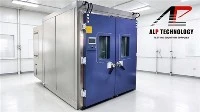


Long-Term Shutdown Tips for Constant Temperature and Humidity Test Chambers
1: Pre-shutdown Preparation and Drying

- Stop all running programs, wait until the chamber returns to room temperature, then take out test samples, shelves and fixtures.
- Drain all water from the humidification tank, water pan, pipelines and filter cartridge. Blow out residual water in the water circuit if possible to prevent algae growth, scaling and pipeline cracking caused by freezing in low-temperature environments.
- Run a drying program (e.g., 50°C for 1 hour with humidification turned off) to thoroughly dry the inner cavity, air duct and humidity sensor.
- Clean the inner liner, door gasket and circulating fan with a soft neutral cloth. Do not use corrosive solvents.
- Keep the chamber door slightly ajar (do not lock it completely) to avoid permanent deformation of the silicone sealing strip under long-term compression.
2: Electrical Protection

- Turn off the main power switch instead of merely shutting down the touch screen standby button, to protect the circuit board from damage by surge and lightning.
- Clean dust accumulated on the condenser, cooling fan and ventilation openings of the control cabinet.
- For storage environments with high humidity, place desiccants inside the control cabinet and test chamber to prevent oxidation and short circuit of the circuit board.
- Recommended regular power-on maintenance: Power on the equipment once a month and run it under no load for 30–60 minutes (the fan, heater and refrigeration start in sequence). This ensures even distribution of compressor lubricating oil and prevents shaft seizure.
3: Storage Environment and External Protection

- Place the unit in a dry and ventilated room; ambient humidity ≤70%RH, ambient temperature 10–30°C. Keep away from direct sunlight, corrosive gas, heavy dust and vibration sources.
- Wipe the outer surface of the equipment and cover it with a breathable dust cover. Do not wrap it tightly with airtight plastic film, which will trap moisture and cause rust.
- Keep the water inlet valve and drain valve closed.
4: Precautions Before Restarting

- Remove desiccants, check whether the door gasket, sensors and wiring terminals are rusted or loose.
- Only purified / deionized water can be filled into the humidification system.
- Perform a no-load trial run for 1–2 hours. Confirm that temperature and humidity accuracy is normal before putting in test samples.

ALP Technology: One-Stop Customized Test Chamber Solutions
Different from ordinary standard testing equipment, ALP Technology focuses on independent R&D, production and customization of environmental test chambers. With core advantages of high precision, strong stability, diverse simulation functions and flexible personalized customization, our products cover constant temperature and humidity test chambers, thermal shock test chambers, high-altitude low-pressure test chambers, aging test chambers and other full-series products. Targeting the differentiated testing demands of various industries, ALP Technology provides one-stop professional testing solutions for global enterprises and research institutions, helping customers improve product quality, shorten R&D cycles, and gain market competitive advantages.
Whether you are standardizing a new product line or solving a difficult failure issue, ALP TECHNOLOGY is ready to help.
✉️ E-mail: info@alp-environment.com
🔗 Website: www.alp-environment.com
"Technological Excellence Rooted in Integrity" - engineered into every test, delivered with every partnership.